Putoniella pruni - Prunus spinosa
Group: Gall (Cecidomyiidae)
Taxon: Putoniella pruni
Host/Substrate: Prunus spinosa (Blackthorn)
Date: 2026-04-24 (Spring)
Habitat: Forest edge, growing beneath Quercus cerris
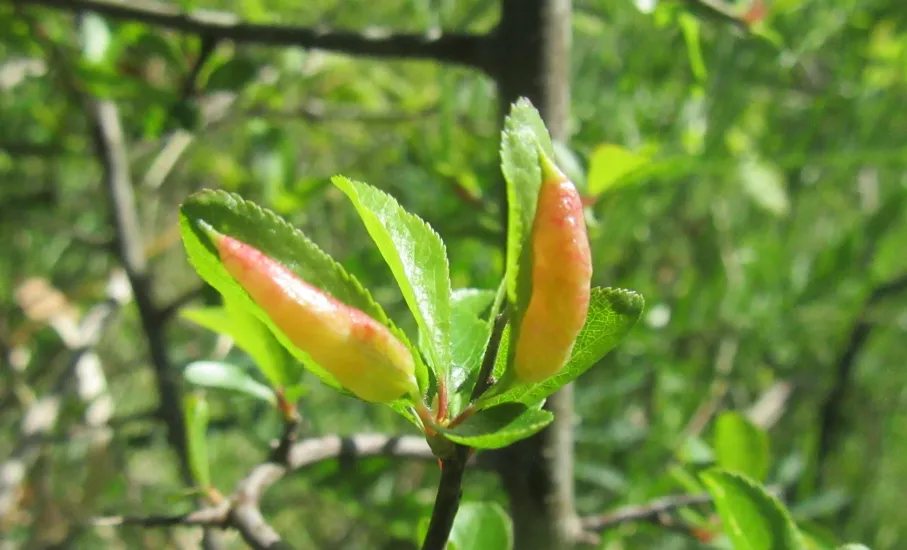 Gall in situ on host plant in natural setting
🌿 Observation
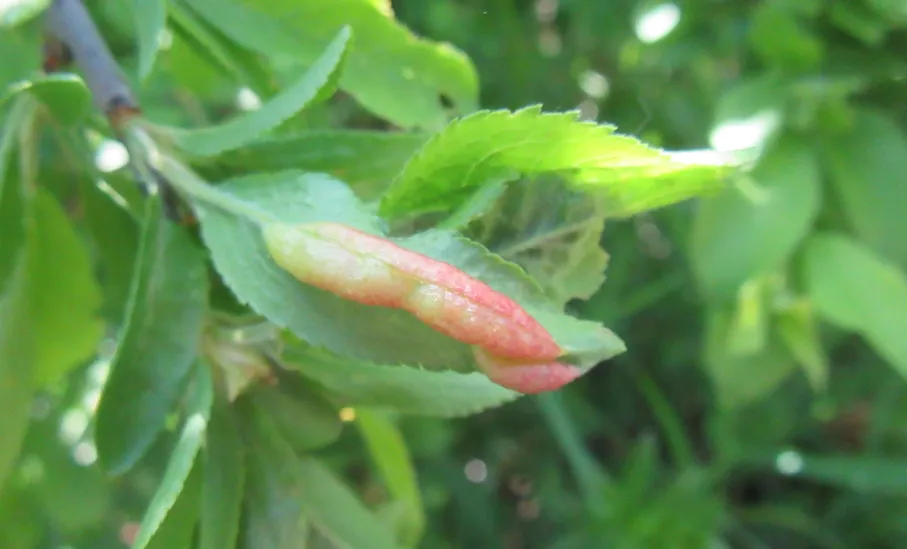 Main diagnostic view of erineum (mite-induced leaf deformation)
While searching for galls on Quercus cerris (Turkey Oak), I didn’t find anything on the oak itself. Instead, my attention shifted to a nearby Prunus spinosa (Blackthorn), where I found these galls.
The red/white galls are hard to miss if you look close enough. They sit on the midribs of the leaves. Various sizes, from about 3 mm to about 3 cm long. I found several, mainly on the lower leaves.
🔬 Notes / Identification
To identify this gall, I worked through a dichotomous key for gallers associated with Prunus.
The gall is located on the leaf, and clearly represents a structured deformation rather than general discoloration or damage.
This rules out:
- aphids, which typically cause leaf curling
- mite-induced erinea, which produce hairy or felt-like growth
- fungal infections, which tend to create spots or diffuse distortions
Instead, the leaf shows a distinct, well-defined gall:
- a firm, elongated swelling
- positioned along the midrib
- often reddish in colour
- with a slit-like opening on the upper surface
When opened, orange larvae are present inside.
This combination of features leads directly to:
→ Putoniella pruni
(Identification based on a dichotomous key for Prunus gallers (see Bladmineerders))
🌱 Context / Ecology
Putoniella pruni is a gall midge that primarily targets the leaves of Blackthorn (Prunus spinosa) and occasionally other plum species. Its lifecycle is closely tied to the seasonal growth of its host plant:
- Adult Emergence (Spring): Adult midges emerge from the soil in April and May. The adults are tiny, delicate flies that are short-lived and generally do not feed.
- Egg Laying: Females lay eggs on the developing tissue of young Blackthorn leaves.
- Gall Formation: As the larvae hatch and begin to feed, their presence stimulates the plant to grow abnormal tissue (the gall) around them. This provides the larvae with both food and shelter.
- Larval Stage: The larvae, which are notably orange in color, develop inside the gall throughout the late spring and early summer.
- Hibernation (Late Summer/Autumn): When the larvae are fully grown, the gall opens, allowing them to drop to the soil, where they hibernate through the winter before pupating the following spring.