Tetraneura caerulescens - Ulmus minor
Group: Gall (Aphididae)
Taxon: Tetraneura caerulescens
Host/Substrate: Ulmus minor (Field elm)
Date: 2026-04-26 (Spring)
Habitat: Roadside verge, young tree in grassy vegetation
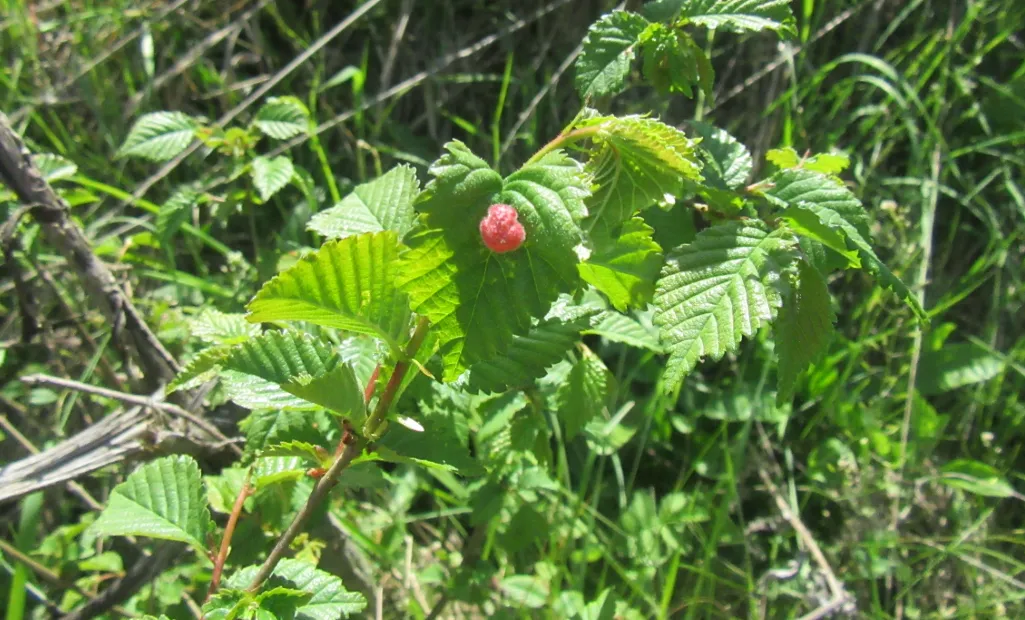 Gall in situ on host plant in natural setting
🌿 Observation
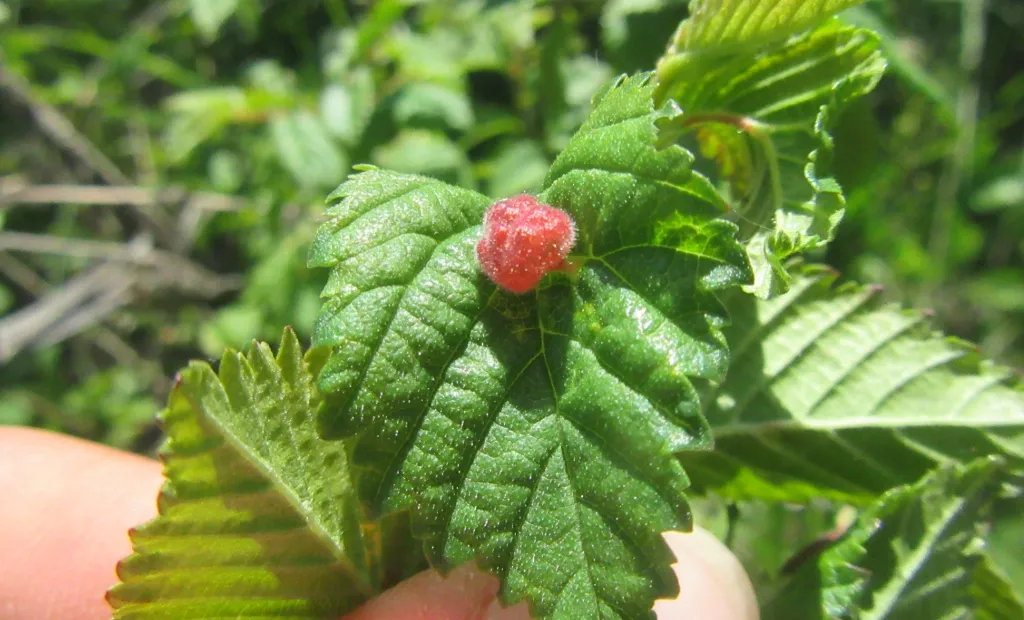 Main diagnostic view of gall structure
While walking the dog, I noticed a small Field Elm growing along the roadside.
Right in the center of a single leaf sat a bright red, spherical gall, like a tiny raspberry. It immediately stood out against the fresh green leaves.
Interestingly, this was the only gall on the entire tree.
🔬 Notes / Identification
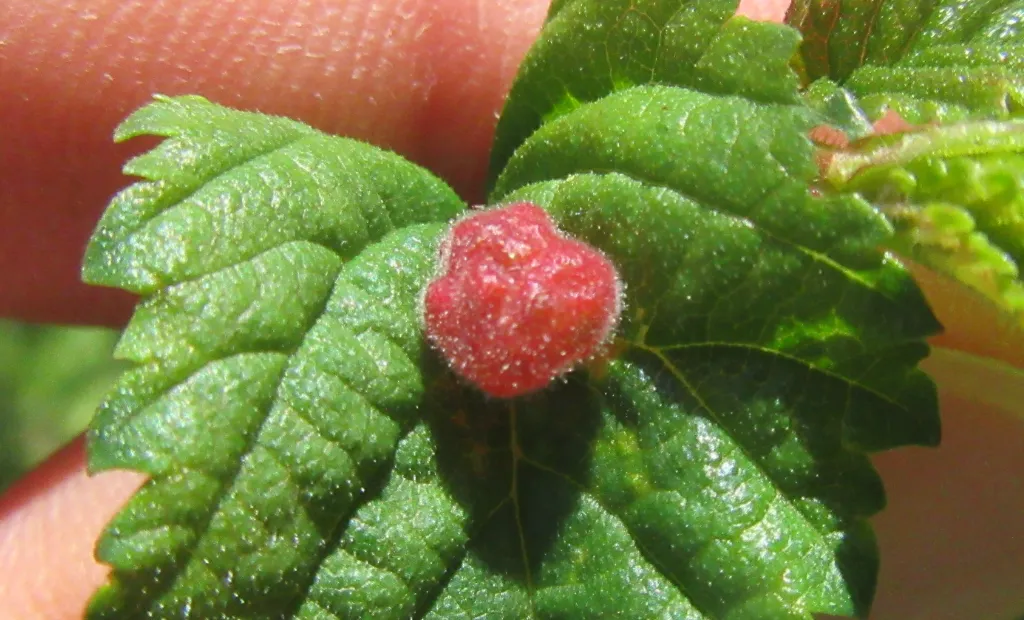 Surface texture of the gall
Identification process
I worked through a dichotomous key for galls associated with Ulmus.
The gall is clearly a distinct, closed structure on the leaf blade, which rules out leaf rolls and simple deformations caused by aphids or fungi.
This leads to the group of enclosed aphid galls on the leaf blade
At the final step, several closely related species remain, so the identification comes down to morphology:
This gall is:
- distinctly round and globular
- strongly red in colour
- short-stalked
- with a fine, slightly hairy surface (not smooth)
This excludes:
- smooth, pear-shaped galls (Tetraneura ulmi)
- spindle-shaped or pointed galls (Tetraneura nigriabdominalis)
- flattened, cockscomb-like galls (Colopha compressa)
What remains is:
→ Tetraneura caerulescens
(Identification based on a dichotomous key for elm gallers — see Bladmineerders))
🌱 Context / Ecology
Tetraneura caerulescens is an aphid that forms characteristic galls on elm leaves.
- Gall formation: Initiated when aphids feed on young leaf tissue
- Structure: A closed, hollow gall develops, housing a colony of aphids
- Protection: The gall provides both food and shelter
- Life cycle: After development, aphids leave the gall and often migrate to secondary hosts (typically grasses)
These galls are most visible in spring, when leaves are still developing and most responsive to manipulation.
Secondary host phase
After leaving the elm, the aphids migrate to grasses (Poaceae), which act as their secondary host plants.
Here, they live underground on the roots, where they form colonies rather than visible galls.
- Host range: grasses (Poaceae), oligophagous
- Location: root systems
- Appearance: aphids about 2 mm long, brown-orange to brown
- Surface: covered with a bluish waxy coating
This root-dwelling phase is much harder to observe, as it takes place below ground and does not produce obvious plant deformations like the elm galls.