Tetraneura nigriabdominalis - Ulmus minor
Group: Gall (Aphididae)
Taxon: Tetraneura nigriabdominalis (T. akinire)
Host/Substrate: Ulmus minor (Field elm)
Date: 2026-04-27 (Spring)
Habitat: Roadside verge, mature tree in grassy vegetation
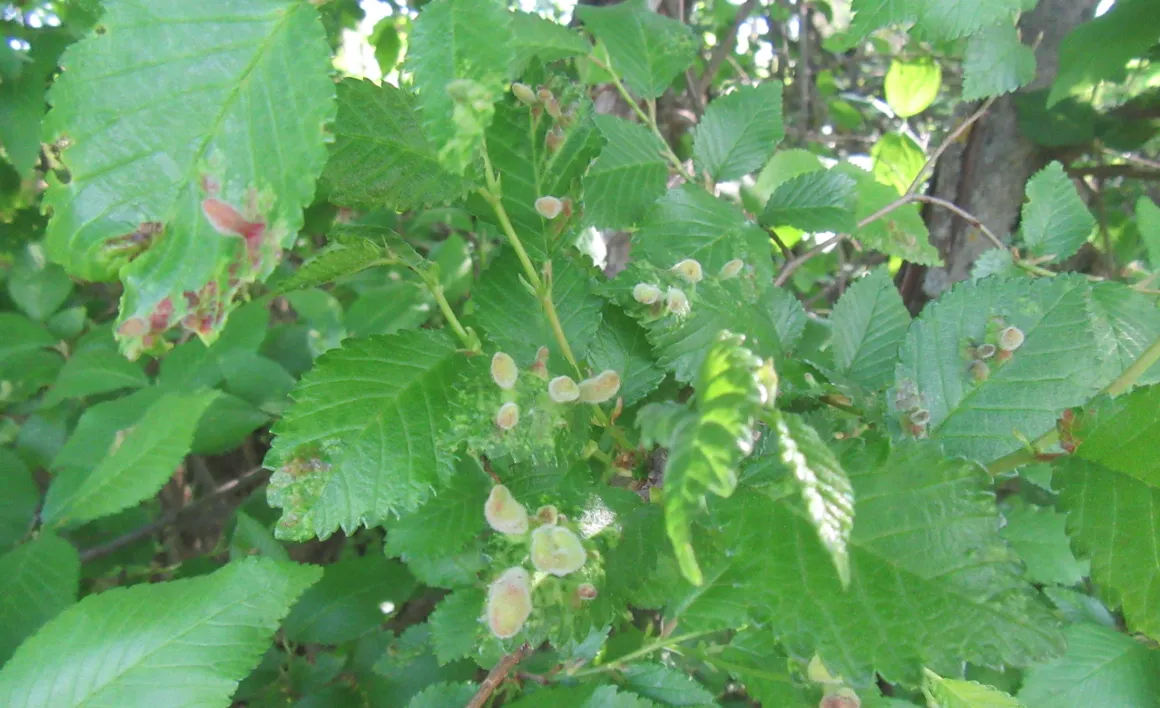 Gall in situ on host plant in natural setting
🌿 Observation
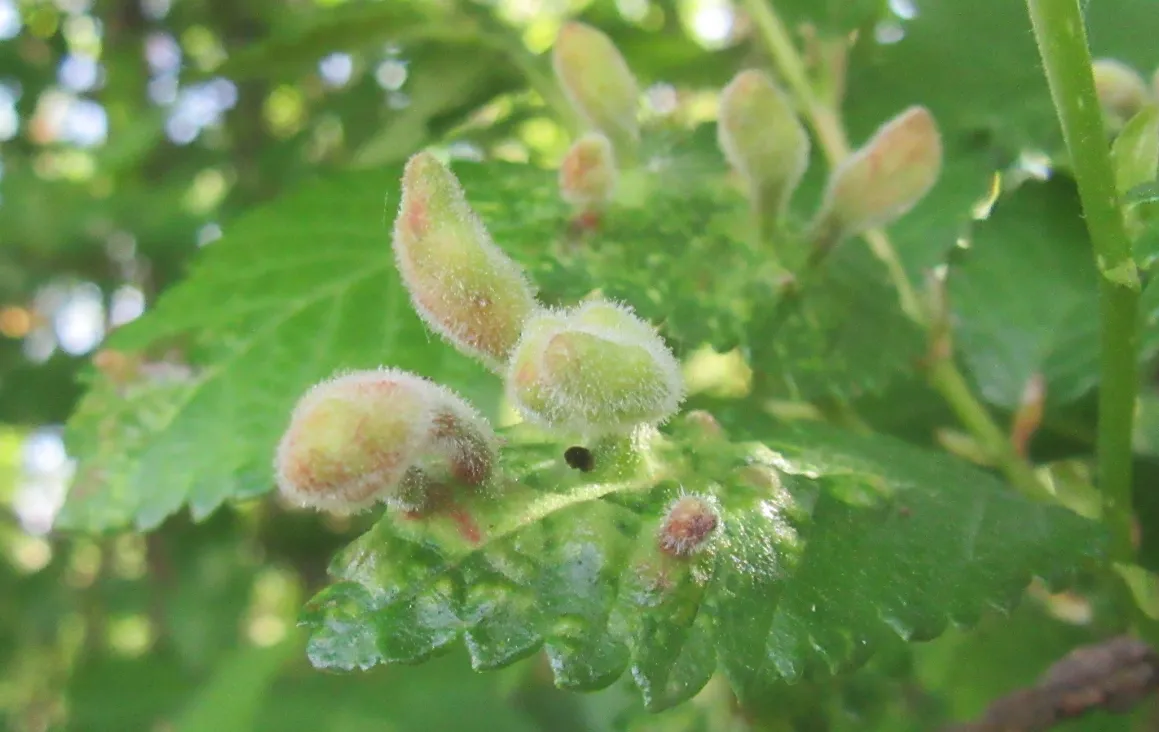 Main diagnostic view of gall structure
While checking young Field Elms along the roadside, I noticed several elongated galls protruding from the leaves.
Unlike the round, berry-like galls from Tetraneura caerulescens, which I observed yesterday, these were more stretched out, almost spindle-shaped, with a pointed tip. Their colour ranged from green to reddish, depending on exposure and age.
They occurred on multiple leaves of the same tree and were much more conspicuous once noticed.
🔬 Notes / Identification
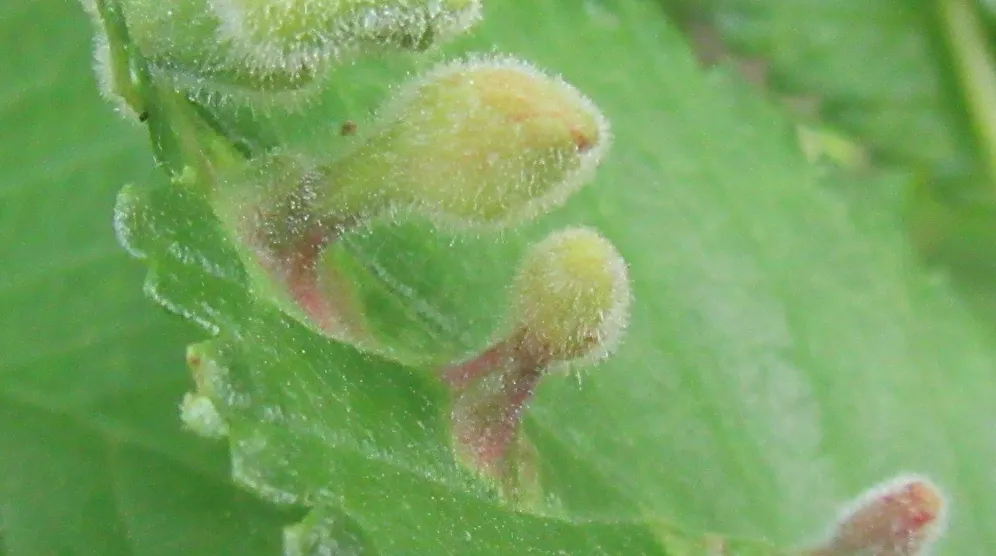 Surface texture and shape of the gall
Identification process
I worked through a dichotomous key for galls associated with Ulmus.
The gall is a closed, protruding structure on the leaf blade, placing it among the aphid-induced pouch galls.
At the final stage, several Tetraneura species remain, which are separated mainly by shape and surface characteristics.
This gall is:
- clearly elongated and spindle-shaped
- with a distinct pointed apex
- larger and more stretched than spherical types
- often green to reddish in colour
This excludes:
- round, globular galls (Tetraneura caerulescens)
- smooth, pear-shaped galls (Tetraneura ulmi)
- flattened, cockscomb-like galls (Colopha compressa)
What remains is:
→ Tetraneura nigriabdominalis
(Identification based on a dichotomous key for elm gallers — see Bladmineerders))
Notes:
While Tetraneura nigriabdominalis is still widely used, recent taxonomic revisions often treat this name as a synonym for Tetraneura akinire.
A 2022 publication by Watanabe et al. determined that Tetraneura nigriabdominalis is an invalid combination, reclassifying the species as Tetraneura akinire (Sasaki, 1904). The revision concludes that the 1899 description likely referred to an Anoecia species rather than a Tetraneura. Access the paper at Zootaxa.
🌱 Context / Ecology
Tetraneura nigriabdominalis is an aphid that induces elongated pouch galls on elm leaves.
- Gall formation: Initiated when aphids feed on developing leaf tissue
- Structure: A hollow gall forms, housing a colony of aphids
- Shape: Characteristically spindle-shaped with a pointed tip
- Seasonality: Most visible in spring during active leaf growth
Secondary host phase
After leaving Ulmus, the aphids migrate to grasses (Poaceae), which serve as their secondary host plants.
Here, they live underground on the roots, where they form colonies rather than visible galls.
- Host range: grasses (Poaceae), oligophagous
- Location: root systems
- Appearance: aphids about 2 mm long, brown-orange to brown
- Surface: covered with a bluish waxy coating
This root-dwelling phase is rarely observed, as it takes place below ground and does not produce visible plant deformities.