Tetraneura caerulescens - Ulmus minor
Group: Gall (Aphididae)
Taxon: Tetraneura ulmi
Host/Substrate: Ulmus minor (Field elm)
Date: 2026-04-28 (Spring)
Habitat: Roadside verge, young tree in grassy vegetation
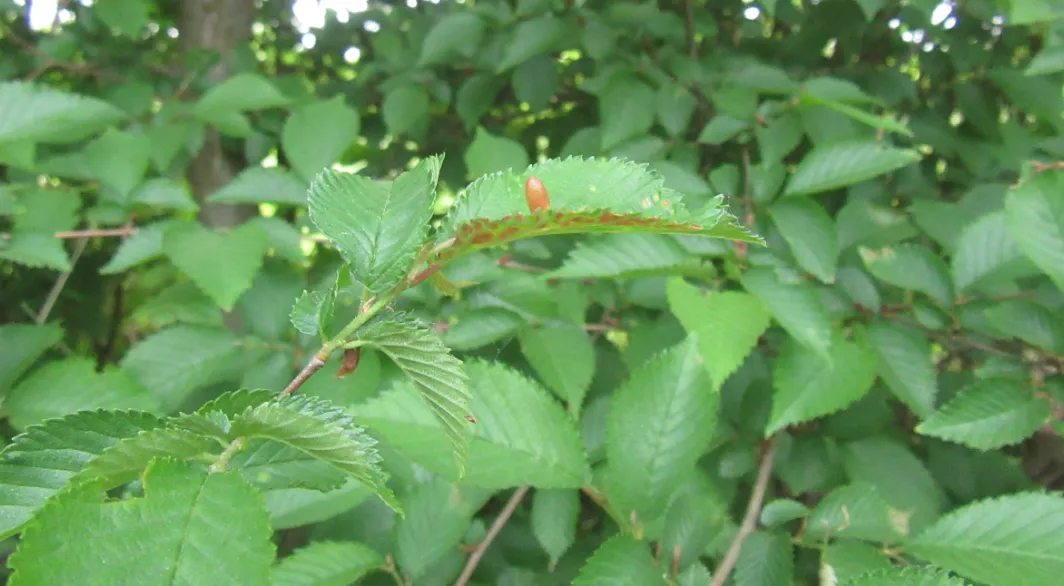 Gall in situ on host plant in natural setting
🌿 Observation
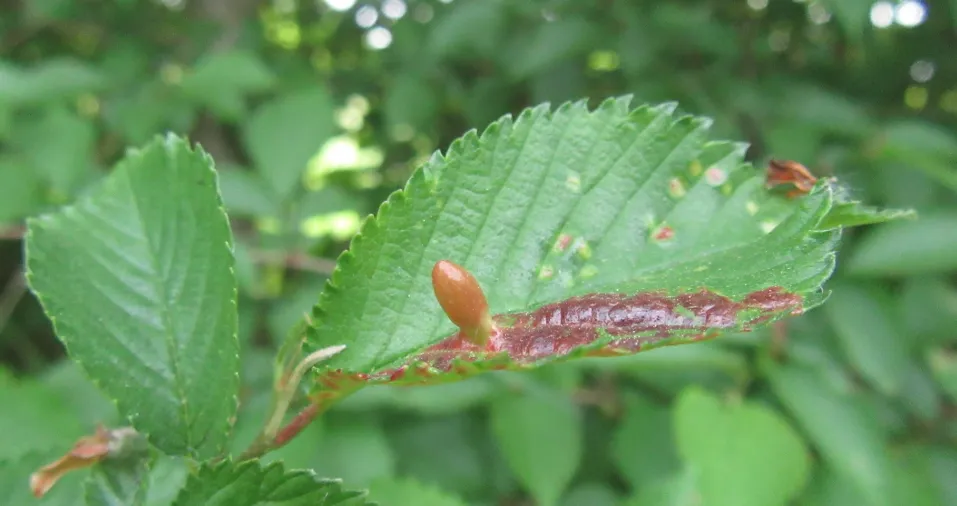 Main diagnostic view of gall structure
While checking young Field Elms along the roadside, I found another type of gall on the leaves.
Unlike the spherical 'raspberry-like' galls of Tetraneura caerulescens or the elongated forms of Tetraneura nigriabdominalis, this one stood upright on the leaf vein like a tiny fig.
The gall is clearly stalked, smooth, and somewhat translucent, with a pale green base and a slightly reddish tint toward the top.
I could find only one on the tree.
🔬 Notes / Identification
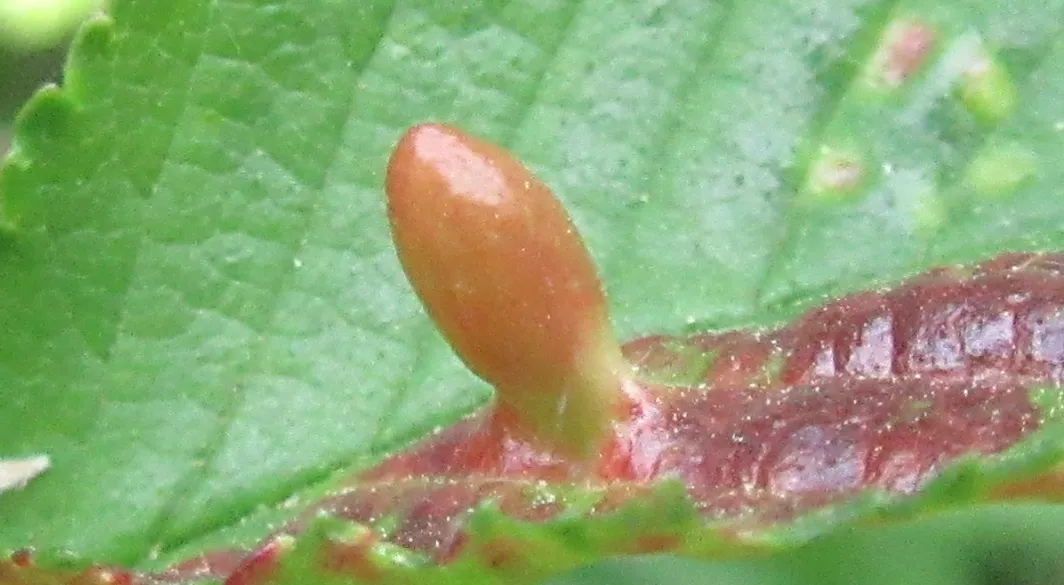 Smooth surface and stalked attachment
Identification process
I worked through a dichotomous key for galls associated with Ulmus.
The gall is a closed, pouch-like structure, clearly higher than 5 mm, placing it among the aphid-induced pouch galls.
At the final stage, the identification comes down to shape and surface:
This gall is:
- egg- to pear-shaped
- distinctly stalked
- with a smooth (glabrous), shiny surface
- pale green with slight reddish discoloration
This excludes:
- globular, short-haired galls (Tetraneura caerulescens)
- spindle-shaped, pointed galls (Tetraneura nigriabdominalis)
- flattened, cockscomb-like galls (Colopha compressa)
What remains is:
→ Tetraneura ulmi
(Identification based on a dichotomous key for elm gallers — see Bladmineerders))
Note
This species is commonly known as the 'fig gall' due to its characteristic shape.
A key distinction from similar species is the completely smooth surface, lacking the fine hairiness seen in some other Tetraneura galls.
🌱 Context / Ecology
Tetraneura ulmi is an aphid that forms characteristic pouch galls on elm leaves.
- Gall formation: Initiated when aphids feed on developing leaf veins
- Structure: A hollow, enclosed gall housing a colony of aphids
- Position: Typically attached to the midrib or major veins
- Seasonality: Most visible in spring during active leaf growth
Secondary host phase
After leaving Ulmus, the aphids migrate to grasses (Poaceae), which serve as their secondary host plants.
Here, they live underground on the roots:
- Host range: grasses (Poaceae), oligophagous
- Location: root systems
- Appearance: aphids about 2 mm long, brown-orange to brown
- Surface: covered with a bluish waxy coating
This below-ground phase is rarely observed, as it produces no visible galls.